M45 | TRIPTYQUE | Archello
type
status
date
slug
summary
tags
category
icon
password
URL
©版权声明本文内容摘录自 Archello,仅作为个人学习与研究案例收集之用。摘录部分已明确标注来源,权利归属原作者及原始发布平台所有。如涉及版权问题,请权利人通过以下方式联系,我们将第一时间核实并处理:联系邮箱:iweiuqi@gmail.com原文链接:


A flexible model for the productive city

TRIPTYQUE • Architects
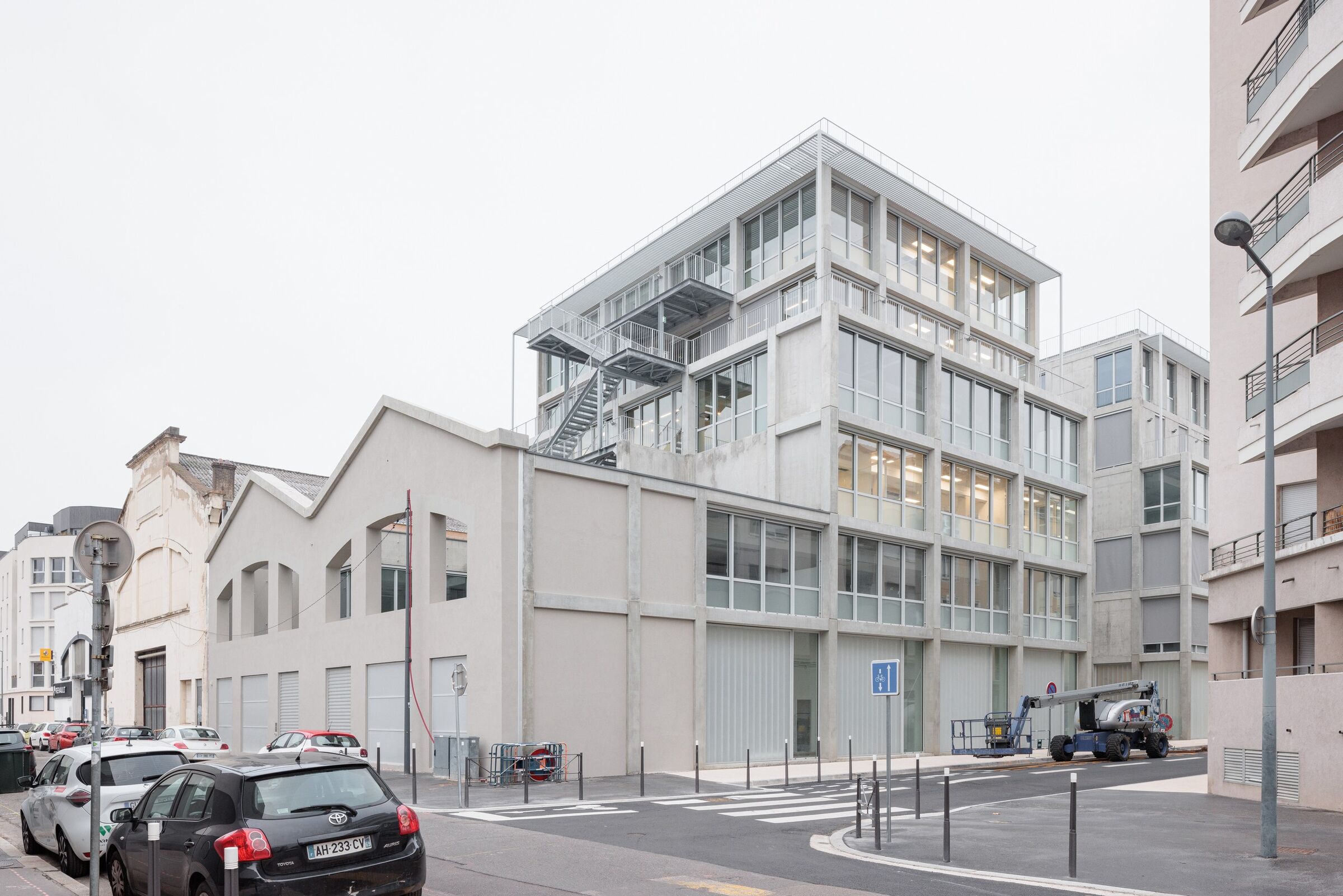
Situated in Villeurbanne’s Mansart district, a neighborhood shaped by its industrial past, M45 offers a contemporary response to the evolving concept of the Productive City. Designed by TRIPTYQUE, the project blends architectural memory with modern urban functionality. The building embodies a hybrid structure—part homage to industrial hangars, part modern insertion—where preserved architectural language is juxtaposed with new construction to support a mix of uses in a compact footprint.

Compact and efficient form
M45 is organized into three volumes around a minimal internal core. This configuration supports efficient use of space and allows for shared access and services, most notably through the integration of external walkways that house emergency egress paths. These elevated walkways establish a rhythmic architectural motif around the inner courtyards, enhancing transparency and visibility across the site while improving circulation. By reducing internal redundancy, the building creates more usable area for programs and encourages adaptability in its use over time.


Flexibility and future use
The structure is designed for adaptability, enabling reversibility in spatial configuration as future needs evolve. Ground and first floors are dedicated to small-scale artisan workshops, anchoring the project in local craft and urban production. Above, office and commercial spaces are designed to accommodate changing functions, with layouts and building systems that allow for repurposing over time. This design foresight supports the building’s long-term sustainability and contributes to its ability to serve shifting demographic, economic, and programmatic demands.

Architectural clarity and spatial permeability
An essentialist approach defines the architectural character of M45. Volumes are composed with simplicity and clarity, supporting both visual and functional legibility. Each volume contains its own streamlined circulation core, and the interconnecting external walkways provide access while encouraging interaction across different parts of the building. The design strategy supports spatial permeability and openness at the block scale, while enabling straightforward access to all units and internal courtyards.
The subdivision of space into smaller components not only supports flexible use but also aligns with the urban grain of the district, maintaining a human scale within a larger building form. Courtyard-facing façades and ground-level porosity further encourage active use and integration with surrounding public space.


Urban integration and productive programming
Beyond form and material, M45 contributes to a more compact and mixed urban model. By integrating production spaces directly into the city center, it supports a decentralized, walkable approach to urban development, where residential, commercial, and craft-based activities coexist. This reinforces the local creative economy while reducing the need for commuting between functionally separated zones.
The arcade-like walkways, open workspaces, and public-facing courtyards make the building a visible and accessible part of the community, aligning with the goals of the Productive City—an urban model that values embedded, flexible, and circular systems of use.

Low-carbon strategies and design for disassembly
Sustainability in M45 is approached through spatial logic and material economy. The building’s compact form minimizes footprint and surface area, reducing thermal loads and construction resource demands. External walkways and natural ventilation strategies decrease dependency on mechanical systems. The structural system and material palette were selected for longevity, while building assemblies were designed for durability and potential disassembly.
By focusing on adaptability, the building supports the principles of circularity. Its internal organization and services allow for reprogramming without major structural interventions, ensuring continued relevance over time. This flexibility directly supports sustainable development by extending the life cycle of the building and minimizing future resource-intensive renovations.
